
A Deep Dive into Korea’s Financial History
By Sharon Stern
Newspaper article reporting Korean Government’s request for funds from the IMF.
In the middle of 1997, the financial systems in Asia began to collapse. At the end of the crisis, South Korea was hit harder than almost all other Asian countries. Right this minute, South Korea is facing another strong financial challenge, despite the fact that South Korea has the 12th largest economy in the world. This month we are going to look at the rise and fall of not just financial markets, but what creates and supports them, causes them to crumble and how those ups and downs affect all of daily life. The history of the Republic of Korea from its establishment in 1948 through the end of its dictatorial rule is turbulent and that is reflected in its social structure and economy.
*Throughout the article - click on any image to enlarge
Introduction
South and North Korea’s GNI Per Capita growth over the years. South Korean economy’s growth has been nicknamed as Miracle on Han River.
South Korea is considered a high-income, highly-developed country. It reached that status extremely quickly after emerging from being a “hermit nation” at the end of the 19th century, then being occupied by Japan for 35 (really 40) years, being immediately re-occupied by the U.S. military, living through civil war and repeated dictatorships. At the end of WWII, Korea was one of the poorest countries on the planet. Its economic growth is recent and unique.
The collapse of Korea’s economic system in 1997, despite the fact that all of Asia also suffered, was considered a huge embarrassment for South Korea. They have called the collapse the second great humiliation for the country, after Japanese occupation.
Let’s examine what brought about that rapid growth through a period of such change and then the eventual complete collapse of the economy.
Korea’s Financial Growth
Post WWII to 1960
South Korea’s First President Rhee Syng Man (on the left) and North Korea’s first leader Kim Il Sung (on the right).
One of the results of the Japanese occupation of Korea from 1910-1945 was that Korea became heavily industrialized. Japan used Korea as a manufacturing base for its expansionistic goals in the Pacific. A lot of the heavy industry, however, was concentrated in the far north and when the Republic of Korea was formed in 1948 and the country was divided, the south had some light industry, but lacked needed infrastructure. 80% of people in the South of Korea worked in agriculture.
The U.S. started giving Korea aid in 1945, which it intended to be used to purchase consumer goods and basic industrial needs. The aid came with strings attached, though not all of the strings caused negative outcomes. The U.S. did force Korea to purchase goods from Japan, in order to rebuild Japan’s economy.
In 1947, the United Nations proposed elections to establish a unified Korean government. The North, under Soviet administration, refused. The south, under U.S. authority, participated and in 1948, the Republic of Korea was formed. Syngman Rhee was appointed president. This was the First Republic of Korea and it lasted until 1960. The government followed practices of the U.S. military, especially toward who they considered to be “leftist” and carried out brutal atrocities, including the Jeju Massacre (see our newsletter article).
Women in the middle of ruins in Seoul during Korean War.
In June of 1950, the Korean War broke out and the brutal policies, as well as massacres, continued. The death of three to five million people, the displacement of 128,000 families and the physical destruction of infrastructure and the indefinitely elongated division of the country left the economy devastated. Urbanization after the war accelerated tremendously. South Korea depended heavily on foreign aid and by 1954 a third of the total budget of the country came from foreign aid, principally from the U.S. Corruption within the Rhee government added to the country’s financial woes. Most of this aid, though it didn’t all trickle down to the population, went directly toward making sure Koreans didn’t starve – there wasn’t a large percentage that went toward reconstruction. As Ji Da-gyum said in The Korean Herald: “At the 1954 Geneva Conference, South Korea finally joined negotiations over the peninsula’s future. But presence was not power. Korea had gained a voice; larger powers still determined the outcome.”
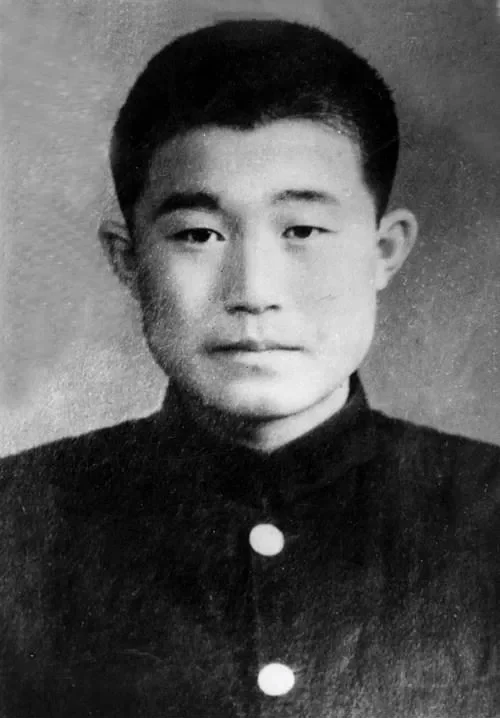
Death of Kim Ju Yeol was the final trigger for the 4.19 Revolution which brought the end of Rhee’s government.
Despite the brutality and corruption of Rhee’s regime and with the U.S.’s strict guidance, he established a formal education system. Compulsory education was implemented at the end of 1949 and opportunities for higher education, which the Japanese limited for Koreans, was greatly expanded. Adult literacy campaigns reduced illiteracy rates from 78% to 10%. By 1982, graduation rates had gone from 54% to 98% for elementary school, 66% to 87% for high school and 28% to 38% for college. Education had previously been a privilege of the elite. The push toward literacy and formal education became the base for Korea’s current education system – a system that is considered a role model throughout the world.
From 1945-1950, with U.S. assistance, land reform and redistribution was carried out. Japan had confiscated a large percentage of arable land during its occupation.
In April of 1960, massive protests against Rhee, rigged elections, corruption and the death of protesting students led to nationwide protests called the April Revolution, which then led to Rhee’s resignation.
1960s – The Second and Third Republics
President Yoon Bo Sun (left) after appointing Jang Myeon (right) as the Prime minister. The second republic was very short lived.
After Rhee’s resignation, the Second Republic of Korea was formed and a new constitution created, but it only lasted a year. A very short-lived parliamentary government was set up in an attempt to reverse the authoritarianism and repression suffered under Rhee. Severe control over political expression was lifted, but factionist and political in-fighting were rampant. Unions were formed, setting up conflict within industry bosses and employees. Military and police from the Rhee government were purged. But economic instability, food shortages, high unemployment inherited from the previous government led the won to lose half of its value from the fall of 1960 to the spring of 1961. The new government created a five-year plan for economic growth, but was ultimately overthrown before they could enact it.
Instability and economic chaos inherited from the Rhee government, more freedom of expression leading to protests of all kinds and a growing movement of nationalism led to governmental weakness and in May of 1961, Park Chung Hee led a military coup to take over power. Park had attended the Imperial Japanese Army Academy during occupation and served for the Japanese army. He was quickly instated into the constabulary army of the U.S. Military Government in South Korea in 1946, only to be accused of being a communist sympathizer and kicked out, though he was strongly anti-communist. In 1960, he formed the Military Revolutionary Committee and he executed the coup before the Committee’s plan to push him out,
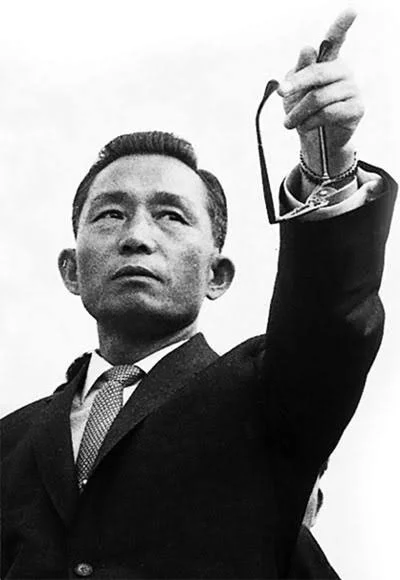
Park Chung Hee.
Park intended from the beginning to use “militaristic disciplined lines” to rule the country. With his strong anti-communist rhetoric, he convinced the U.S. to accept the coup. On May 20, four days after the coup, John F. Kennedy sent a message confirming friendly ties to South Korea. The U.S. willingly chose to ignore the fact that Park wanted to modernize the country by use of military force, in the style of the Japanese militarism he was trained in. One of his first actions was to arrest homeless people and detain them in welfare centers.
Elections were held in October of 1963 and Park narrowly won. Civilian candidates were deeply divided and instead of uniting against Park, they remained in their separate corners and consequently lost. Third Republic of Korea and a new constitution was established on December 17, 1963. Park was subsequently re-elected in 1967 and 1971 and ruled until 1972.
Industrial Expansion Under Military Rule
Park Chung Hee signs the treaty to normalize diplomatic relationship between Korea and Japan in 1965.
The South Korean economy grew exponentially during Park’s reign. With the help of U.S. aid, he invested in infrastructure across the country, including the Seoul metro and the nationwide express system. Park prioritized exports over imports and production of labor-intensive manufactured goods. Exporters were given huge tax breaks and heavily subsidized loan credits. The won was heavily devalued several times in 1961, 1964 and 1965 and the value was then allowed to float, requiring the influx of foreign aid to stabilize its value. Both goods and technology began to be imported from Japan.
Park’s attitude toward growth at any cost was pretty clear. He was quoted as saying, “No matter how bitter an enemy they may have been yesterday, if our present and future require it, would it not be wise, for the benefit of the nation and the welfare of the people, to join hands with them?” Park didn’t care what needed to be done in order to achieve economic growth and he would use military might to make sure he achieved it.
Miracle on the Han River
South Korea GDP (PPP) evolution from 1911 to 2008 in millions of 1990 International dollars: log scale. Source: Angus Maddison.
The explosive economic growth that Park achieved was coined as the Miracle on the Han River. The Han River runs through Seoul, splitting it. Prime Minister Chang Myon in 1961, during the Second Republic of Korea, admiring what was called “Miracle on the Rhine” - referring to the accelerated growth of West Germany after WWII - said, “In order to achieve a so-called "Miracle of the Banks of the Han" ("한강변의 기적") comparable to Germany's, we should have austerity and diligence comparable to that of the Germans.“ The term Miracle on the Han River was repeated the next year by General James Van Fleet, who had led forces in Korea during the Korean War. The term stuck and is the term used to refer to this period of unique and rapid growth.
The economic boom came at the expense of labor rights and the organization and protection of workers, which were completely suppressed during the Third Republic. There were no labor protection laws nor a minimum wage, no sick time or compensation for job-related injuries. Similarly to Korea’s occupation under Japan, the labor force was seen as a dispensable commodity.
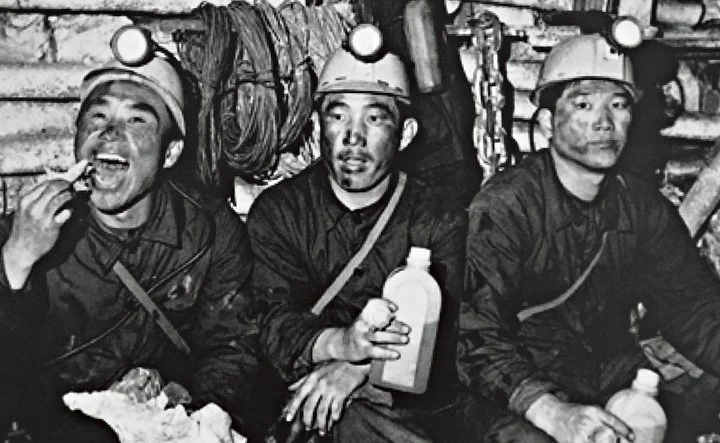
Korean miners in Germany.
South Korea established a migrant worker relationship with West Germany, which West Germany had begun with other countries post-WWII, due to labor shortages from the loss of workers after the war. South Koreans went to West Germany as miners and nurses under a temporary guest worker agreement called Gastarbeiter. By the mid-1970s, 20,000 South Korean workers had gone to work in Germany. This carefully planned agreement negotiated by Park (though Germany used workers from a number of different countries) was intended to bring in an influx of foreign capital back to South Korea. Park negotiated loans from West Germany and, essentially, traded migrant workers for the loans and established a strong relationship with a European country. Workers, thinking they were going to earn higher wages, found themselves faced with brutal work hours and conditions, racism, sexism (in the case of nurses) and exoticization. Not everyone survived to come back home.
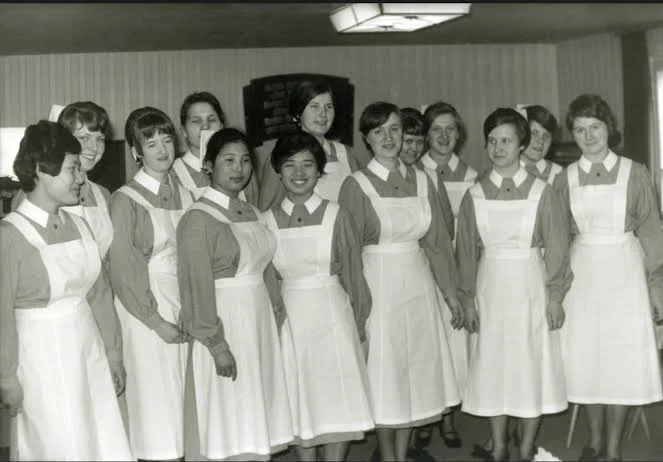
Nurses in Germany
Park sent workers to other countries as well, including throughout the Arab world – a practice that increased and continued into the 1980s. Arab countries liked Korean labor because male workers came unaccompanied and stayed for only short periods. Workers to Arab countries, particularly Saudi Arabia, earned more than they could at home, but they had to remit up to 80% of their wages. Construction labor worked in 24-hour shifts and the toll to Korean worker’s health was often high.
This period saw a fundamental change in the scale and type of capital inflows. Grants (aid as gifts), which had dominated previous decades, gave way to loans as the primary form of assistance. As Korea's economy began to grow, private capital also started to play an increasingly important role. During the Third Republic, South Korea received $119 billion from the U.S. and $800 million from Japan. Combined with cheap and controlled labor, this money allowed Park to rapidly build the economy. South Korea was expected to return the favor for its unusually large financial aid from the U.S. South Korea ended up sending 320,000 troops to Vietnam, where more than 15,000 were killed or injured.
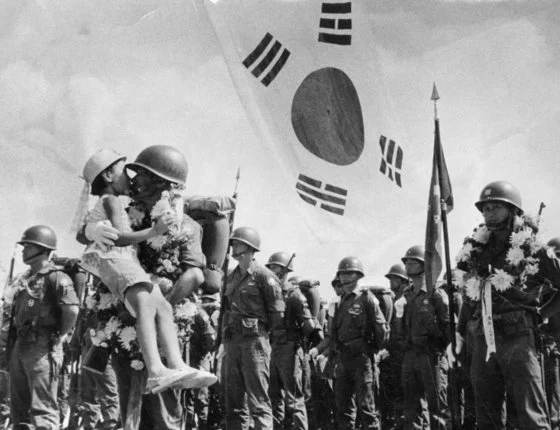
Korean soldiers returning home after Vietnam War.
In order to help feed the U.S.’s Military Industrial Complex, Park invested in large-scale manufacturing, which bolstered the chaebol system that continues to exist today. U.S. Military contracts have very specific technological requirements, often limiting production to U.S. companies that can meet the requirements. During the Korean War, South Korean companies began trying to fill these U.S. needs, but during the Vietnam War and with the help of imported technology from Japan, Korea began to obtain U.S. military contracts.
What is a Chaebol (재벌)
Park Chung Hee with Lee Byung Chul, the first Chairman of Samsung.
The word chaebol comes from the Sino-Japanese word zaibatsu that means “wealth clan”. The Japanese had zaibatsu throughout their economy from the end of the 1800s through WWII. A chaebol is a large conglomerate business, often with many subsidiaries, managed by an individual or family that enjoys great privilege within its government’s governance.
Immediately after WWII, Korea’s economy was based heavily on agriculture and light industry, but that needed to change for survival. The existence of chaebols in South Korea came about initially because of the Korean War, but flourished during the Vietnam War. The war interrupted industrial production, but the government still had to pay for the expenses of the war. This meant they printed more money, which led to very high inflation. As a result, the government decided to give strong financial incentives to private companies during the 1960s and 1970s. Because the government controlled the markets, these companies could easily thrive..
Corruption was rife in both the government and the chaebol companies during this time. There was no government monitoring system to make sure that chaebols used the resources the government gave them efficiently. The management of chaebols was not transparent and because they were given easy access to loans and governmental monies, this created an illusion that the business sector was stable and profitable, even as the accumulated great debt. This was a considerable factor in the financial collapse of 1997.
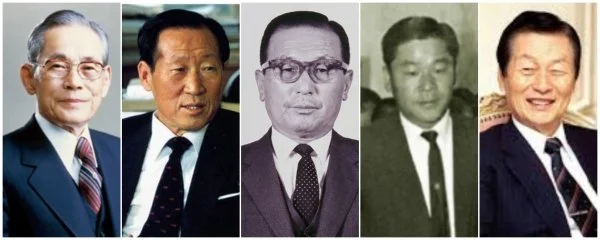
From left to right. Lee Byung Chul (Samsung), Jung Ju Young (Hyundai), Koo In Hoe (LG), Choi Jong Gun (SK), Shin Kyuk Ho (Lotte)
Park Chung Hee’s push towards rapid industrialization included promoting these large, conglomerate businesses. The government channeled funds to companies it selected for projects and guaranteed repayment to foreign creditors. These companies were allowed to operate essentially as monopolies within their industries. Market competition didn’t exist. These companies were owned by individuals or families as opposed to stock holders. Banks were prevented from owning and controlling shares in these companies. The chairman of a typical chaebol possesses a small portion of the equity in the companies under the large umbrella of the chaebol but is very powerful in making decisions and controls all management. The structure of chaebols is completely hierarchical and promotions are not often based on merit.
Because of the governmental advantages given, the limited number of individuals in control of the companies, the opacity of their structure and the enormity of their manufacturing contracts, chaebols became too big to fail.
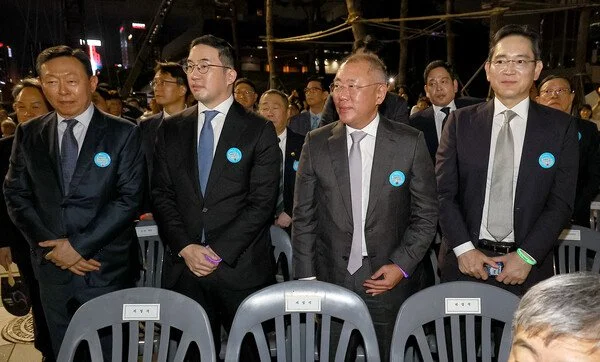
Third Generation Chebeols Left to Right: Shin Dong Bin (Lotte), Koo Gwang Mo (LG), Jung Ui Sun (Hyundai), and Lee Jae Yong (Samsung)
Chaebol names that are easily recognizable worldwide include Samsung, Hyundai Motors, LG, Lotte, Hanjin (Korean Air), SK Group (semiconductors and computer chips), most of which had their beginnings making military weapons and supplies. Samsung, founded by an industrialist who had ties to Japanese capital and the U.S. military market, had developed his company during Japanese occupation and knew how to position himself to take advantage of Japanese investment. Hyundai was able to competitively bid against U.S. companies for U.S. military contracts during the Vietnam War. Hanjin, which is a shipping giant, obtained contracts for moving military goods during the war. Park’s offer to send troops into Vietnam when Japan was not making that offer, also cemented a relationship between the U.S. and South Korea that opened the doors for larger and longer contracts with Korea’s chaebols. Korean chaebols not only gained huge profits with these contracts, but they also gained valuable experience and technological knowledge that allowed them to continue to grow.
1970s
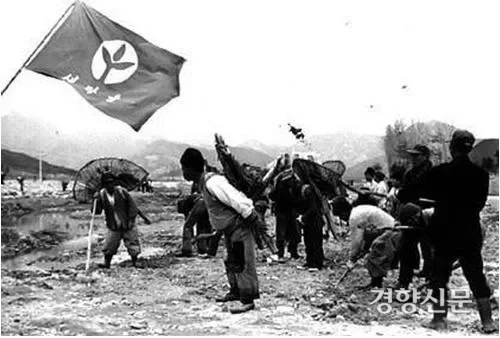
Saemaul Undong, the New Village Movement.
In 1970, Park began reforms of rural communities called the Saemaul Undong (새마을 운동) or New Community Movement, encouraging rural development by collective cooperation. This restructuring included building rural infrastructure and housing as well as education and health care for rural farmers. The goal of this program was supposedly to bridge the gap between rural and urban standards of living. Local traditions and customs, seen as superstitious by the government, were abolished in favor of military control.
Park was narrowly re-elected in 1971. Shortly before being sworn in, he declared a state of emergency, suspended the constitution and dissolved the National Assembly. This is described as a self-coup so that he could return to dictatorial powers. He drafted a new constitution, called the Yushin Constitution, which was approved in a heavily rigged procedure. The new constitution was extremely authoritarian. The Fourth Republic of Korea began. The Fourth Republic was oppressive and included many civil crack downs while the chaebols continued to grow with almost unchecked power. Park focused on military strength and industrially on weapons, steel and electronics as well as developing missiles to try to deter North Korean threats. In October of 1979, Park was assassinated by the director of the KCIA (Korean National Intelligence Service).
1980s
Chun Doo Hwan.
Immediately after Park’s assassination there was a period of political turmoil. In May of 1980 Chun Doo-hwan led a coup and expanded the already existing martial law to the entire country (Jeju Island had previously been excluded). The expansion abolished the constitution, all political parties, closed universities, banned political activities, essentially shut down the press and established the Fifth Republic of Korea. Push-back from the public led to protests and eventually the Gwangju Massacre, which, in turn, led to more and more protests. You can read our article on the Gwangju Massacre here.
Because of the political crack downs after the implementation of the Yushin Constitution and at the end of Park’s life, the economic situation in the country had taken a downturn. Inflation had risen and the balance of loans to loan pay-back had deteriorated. Chun set the economy as a key priority for his government. He implemented tax relief for chaebols and the privatization of banks. He exchanged strict price controls for establishing the Korean Fair Trade Commission, though its effectiveness was limited by the fact that it was subordinate to the Economic Planning Board which favored the chaebols. The privatization of banks also did nothing to eliminate the favoritism shown to chaebols. However, tax relief and interest rate reductions did, eventually, bring back balance-of-payments and by 1986, the country was able to begin reducing its foreign debt.
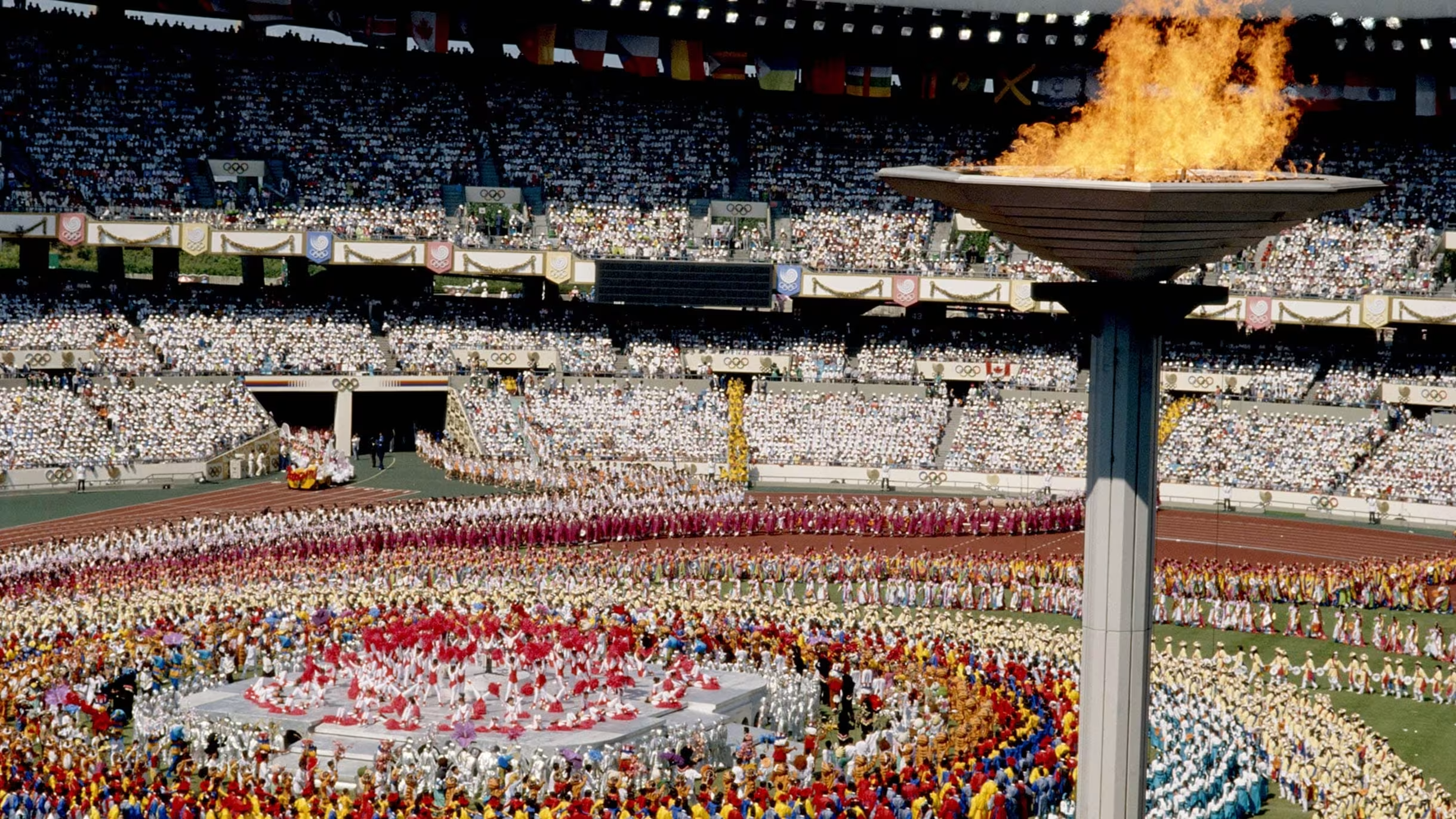
1988 Seoul Olympic. Photo Credit: Olympics Website
In 1982, Chun faced a financial crisis called the Lee-Chang (Lee Cheol Hee- Chang Youngja) Scandal that was caused by a curbstone or speculative broker who gave loans to industrial firms demanding many times the loan’s value in return. The manipulation of the loans was valued at almost $1 billion and when the scheme was discovered, it ended up in the collapse of two major industrial firms. One of the investors was directly related to Chun and eleven cabinet members ended up resigning because of their involvement.
The 1981 constitution that Chun had implemented restricted the president to a single seven-year term. In 1987, he declared Roh Tae-woo as his (the only) party’s only candidate for president, essentially declaring who would succeed him without any public input. Public outcry triggered the June Democracy Movement – a series of very large demonstrations across the country – which led not only to Chun stepping down but to the implementation of direct presidential elections for the first time in the Republic’s history. Roh won the election with just 37% of the vote, but this was a definitive turning point for the country.
In February of 1988, Roh took power and the Sixth Republic of Korea was established and remains to this day. The 1988 Summer Olympics were held in Seoul, adding to South Korea’s international recognition and influence and financial stability.
1990s
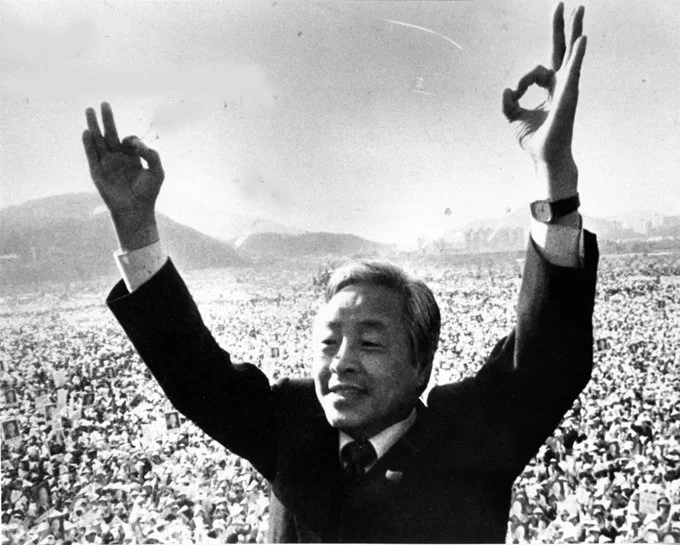
President Kim Young Sam.
In 1992, Kim Young-sam was elected as the first civilian president of South Korea. Kim’s government set the goal of disassembling the authoritarianism of his predecessors. Presidents Chun and Roh were both indicted on charges of bribery, illegal funds and Chun was held responsible for the Gwangju Massacre. Relations with North Korea improved, though stalled, when Kim Il Sung died. The country also faced a number of catastrophes in quick succession, including sinking of the Seohae ferry (1993), the Seongsu Bridge collapse (1994) and the Sampoong Department Store collapse (1994).
Kim attempted to help smaller and independent businesses by providing more loans, but this didn’t take away any of the power that the established chaebols already enjoyed.
Internationally, South Korea stepped up and became a more active player. In 1991, both North and South Korea joined the United Nations. In 1995, South Korea joined the World Trade Organization. In 1996, they joined the Organization for Economic Co-operation and Development (OECD).
The Asian Financial Crisis
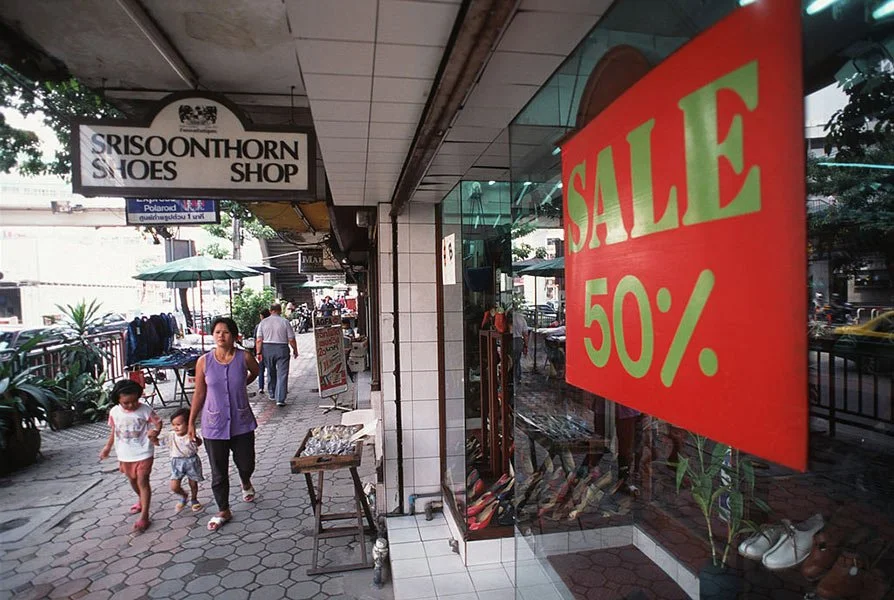
A Bangkok, Thailand, shop offers 50% off in a desperate attempt to lure customers who have lost their spending power after the economic crash of 1997. (Photo: Peter Charlesworth/Light Rocket/Getty Images)
In July of 1997, a financial crisis began in Thailand when the value of the Thai baht collapsed because the government had to allow the baht to float or fluctuate due to a lack of foreign currency and the baht being pegged to the US dollar. Money and investments rushed out of the country. The crisis had a chain effect throughout Asia and in the end, Thailand, Indonesia, South Korea, the Philippines, China, Hong Kong (still independent), Malaysia, Mongolia, Singapore and Japan all were affected. South Korea suffered more than almost any other country.
South Korea and the Financial Crisis
Although South Korea was one of the last Asian nations to be affected by the financial crisis, it was hit harder because it was essentially hit twice. The first hit had to do with South Korea’s debt situation.
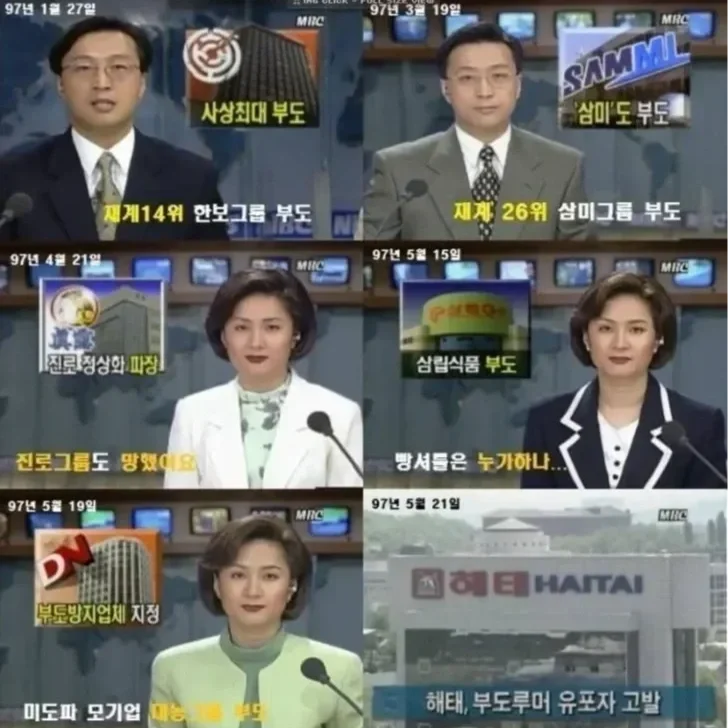
Korean News broadcast reporting bankruptcy every day.
Chaebols, with their opaque business practices, but enormous reliance on borrowing to fund huge projects, ended up in financial trouble. Their debt had really been hidden from the public or even governmental eye and now was out there in the open and the situation was grim. Their debt-to-equity ratios were 400-500%, meaning that they borrowed 4-5 times more than the value of what they owned.
Hanbo Steel, a chaebol, collapsed in January of 1997 with $6 billion in debt. This should have been a huge red flag to the government of more trouble to come. Both Kia Motors and Daewoo Motors were hiding enormous debt as well.
Bankers feared that chaebols would go bankrupt, so they allowed them to roll over their loans each time they were unable to repay their debts. Many banks did not believe that the chaebols were capable of collapsing and that the more they borrowed, the safer they were. That theory was proven wrong when many of these businesses ended up collapsing or nearly collapsing during the financial crisis.
South Korea’s banking sector was burdened with underperforming loans – loans that were not being paid back on time or not paid back at all – because of the behavior mentioned above. Korean banks had extended loans to chaebols not on the basis of creditworthiness but on the basis of government direction and political relationships. In addition, merchant banks had been taking short-term international loans, but making long-term domestic loans, causing liquidity problems. Eventually, excess debt caught up with companies and they either failed or had to be taken over by larger companies.
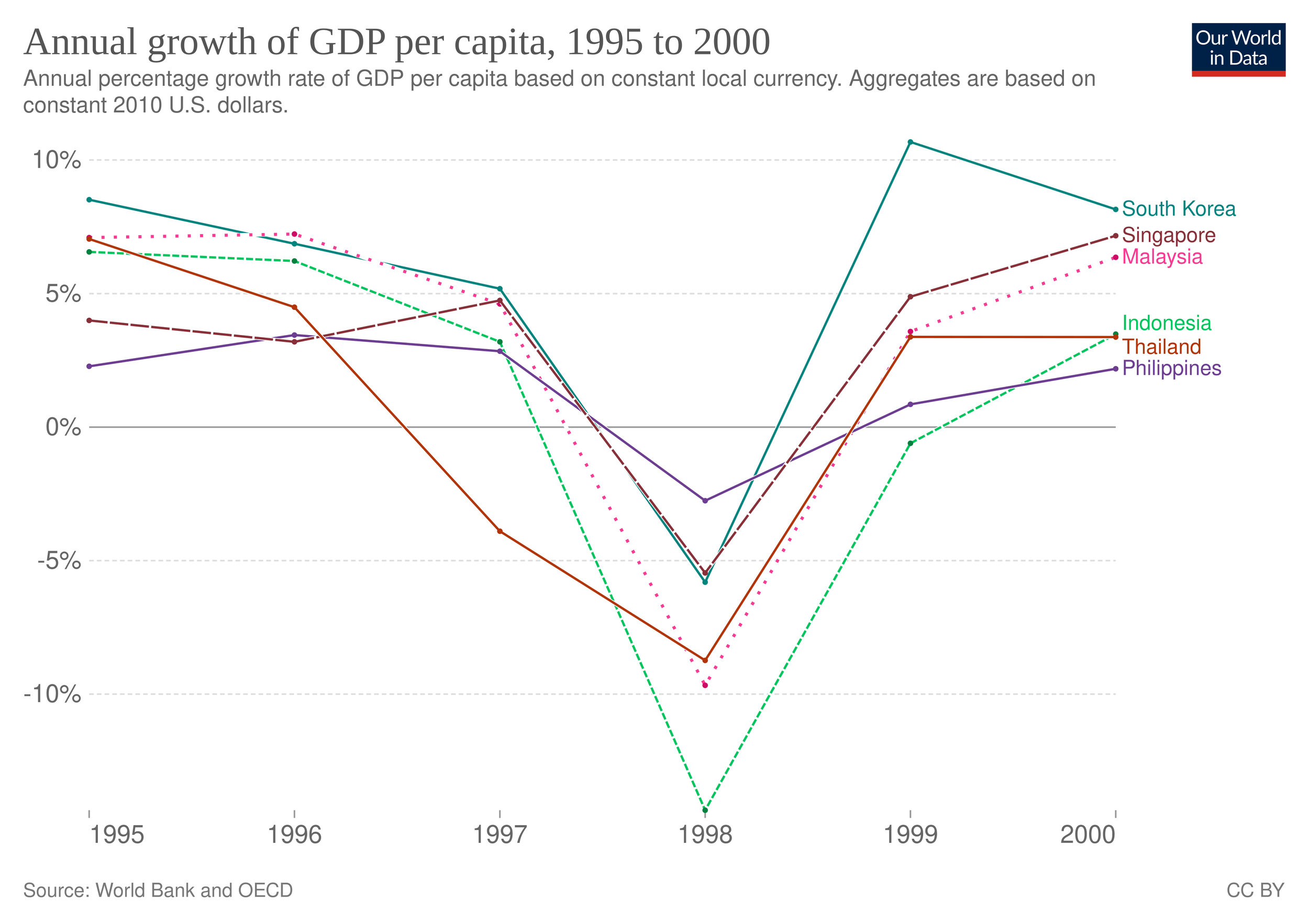
At the same time, the Bank of Korea was spending federal reserves in order to prop up the sagging value of the won. They ate up those reserves more quickly than expected. Korea was in a situation where it was going to default on the payment of its international debt. South Korea’s credit rating was lowered from A1 to A3 in November of 1997 and then downgraded again to B3 in December. The stock market plunged multiple times.
An economist team from the IMF was sent to Seoul to create a bail out package for the country. What they put in place caused the second hit.
What is the IMF
The IMF.
The International Monetary Fund or IMF is an international financial institution of the United Nations, which was established in 1944 and is headquartered in Washington, D.C. Its mission is "working to foster global monetary cooperation, secure financial stability, facilitate international trade, promote high employment and sustainable economic growth, and reduce poverty around the world." The resources come through a quota system provided by the 191 member nations who contribute funds that are pooled and from which they can borrow. When a country takes a loan, the IMF imposes financial reforms on the country in the hopes that those reforms will prevent the country from needing future help.
The IMF has been criticized for requiring austerity measures that are too strict and therefore hinder recovery by a borrowing nation. It has also been criticized for propping up dictators, preventing importation of needed food (because purchasing is supposed to be limited) and weakening fragile health systems (again, because purchasing has to be limited) in developing countries.
South Korea and the IMF in 1997
A South Korean labor union member of Seoulbank, one of South Korea's most bad-debt burdened commercial banks, looks downcast. (Photo: Choo Youn-Kong/AFP/Getty Images)
The crisis that Korea suffered in 1997 has been likened to having a stroke and it’s a good analogy. A stroke is a sudden blockage of an artery and can take a life when that life appeared to be functioning just fine moments before. Strokes usually hit people with some sort of condition, whether or not that condition is known about in advance, such as a history of smoking, high blood pressure, diabetes, etc. There were underlying causes to the collapse that happened in South Korea and there were warning signs that were ignored.
On December 3, 1997, South Korea and the IMF signed a financial agreement totaling $58.3 billion, with a very long list of conditions attached. “The IMF committed emergency funds amounting to $21 billion. An additional $14 billion was committed by the World Bank and the Asian Development Bank. As a second line of defense an additional $23.3 billion was pledged by the United States, Japan, Australia and other
interested countries.” (The IMF Rescue Program in Korea: What Went Wrong? By Hyun-Hoon Lee). It was assumed that this financial package alone would be enough to turn the markets around.
The IMF required Korea to implement very strict measures that included tightening monetary policy, austerity measures and the immediate closure of failing financial institutions. Measures included reducing government expenditures; enhancing labor market and exchange rate flexibility; pursuing trade liberalization; and giving more leeway to foreign investors in the domestic market. A third of merchant banks were closed. Korea was also asked to sharply raise interest rates from 12.3% to 20.7%. As anyone who has taken out a loan would know, 20% interest rates are very high.
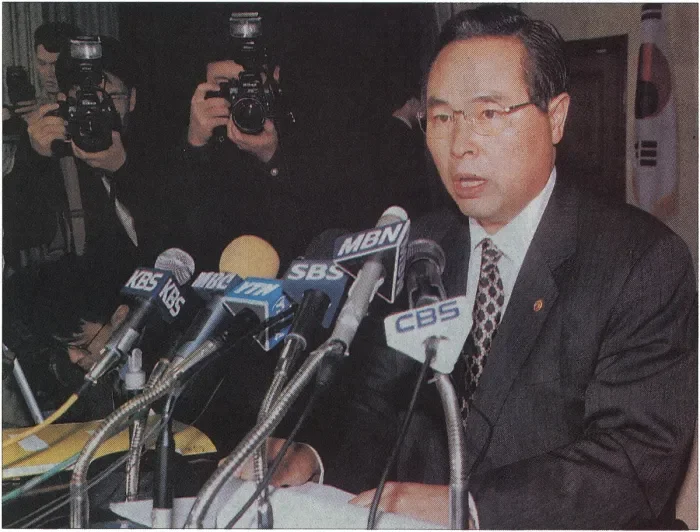
Korea requests the IMF to bail out the country.
Two major commercial banks, Korea First Bank and Seoul Bank, were nationalized instead of being closed. That required a very large influx of capital – about 5% of GDP. The government also made deposit guarantees for accounts in those banks. These two steps help prevent a run on the banks.
Other underperforming banks were closed; some banks were required to present plans that would create high returns by the first quarter of 1998. But we know Korea’s banking sector was weighed down with non-performing loans (NPL) - loans where the payments are coming in late or are predicted to not be fully repaid. The result of all of these IMF requirements was that the percentage of NPL loans spiked suddenly. This caused the stock market to fall. The value of the won dropped. This was a worse scenario than the IMF had predicted. Korea was going to have to default on paying back the IMF by the end of December.
The crisis touched everyone in the country. Within the first quarter of 1998, many small and mid-sized businesses, unable to pay their debts with high interest rates, closed. This spiked the number of NPL loans even higher. By the end of 1988, the impact statistics were staggering. 1.66 million people had lost their jobs and unemployment reached 6.8%. 80% of households had significantly lower incomes. People stopped spending – 29% less than when the crisis had started. The GDP (Gross Domestic Product – the total value of goods and services produced annually by a country) dropped 5.8%. Wages for those who still had work dropped by 2.5% while inflation hit 9.55% in February.
Homelessness and The Role of Nationalism and Attitudes Towards Women’s Roles
Women were protesting against the policies to fire female workers before male workers. Photo Credit: Korean WomenLink.
Homelessness rose sharply during the crisis. Homeless people could be seen in numbers that hadn’t existed since the end of the Korean War. It was called IMF Homelessness. In a country where the last decades had seen nothing but strong economic growth, this site was shocking. The government established shelters and social assistance programs, but they were grossly imbalanced. Several decades of military rule had pulled the country back into conservative concepts of gender roles. The man was supposed to be the provider for the household. If there was no man, essentially there was no household. Men were offered shelters and job assistance, but women were not – they were supposed to get help from some man. Actually, it was originally assumed that there were no homeless women. Interviews with a number of government employees show this belief. If a woman was homeless, it wasn’t because of the IMF crisis but because they were mentally ill or drug addicted or some sort of whore. The government didn’t even track gender in their count of homeless people.
The stresses of losing jobs caused domestic violence to increase. Women and mothers with children who left home and ended up on the streets as a result of domestic violence were considered somehow immoral and incompetent to do their job as homemakers. Government officials didn’t want to recognize the increase in domestic violence as due to the financial crisis.
Suicide rates also increased by 45% during the crisis.
Gold Collection Campaign
Korea launched Gold collection campaign to bail out the country.
The country started a gold collecting campaign in the hopes of paying off the debt to the IMF. It was begun by the Saemaeul Women's Association Central Association, one of the Saemaul Undong organizations. People that wanted to show their patriotism were encouraged to bring objects that they had that were gold to specified banks. The campaign went in stages from January through April of 1998. Almost 227 tons of gold was collected, which was valued at $2.17 billion. This only represented 3.7% of the IMF debt, but the psychological impact was huge. By demonstrating collective effort and national will, South Korea restored creditor confidence and stabilized its foreign reserves.
Recovery
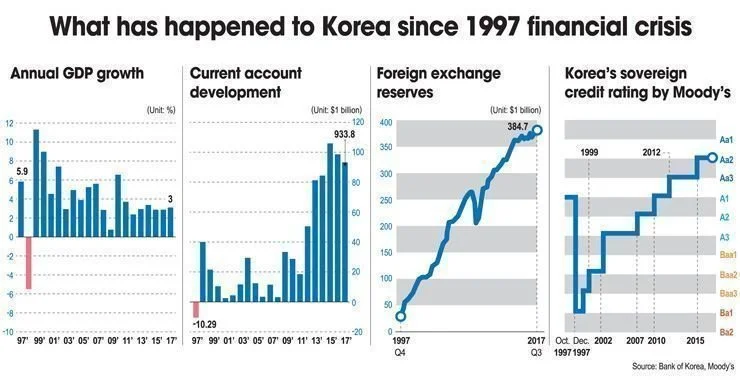
The financial crisis of 1997 hit hard and fast and overall, its recovery came relatively quickly as well. Economists have analyzed this crisis and there are many opinions about its causes. Criticism of the IMF response in the situation has been strong by some. It is obvious that South Korea matured and became more economically robust as a result of the crisis. The crisis came less than a decade after breaking away from dictatorial rule and just a few years after electing its first civilian government. The growth of South Korea, overall, from an underdeveloped, poverty-stricken nation in 1945 to the 12th largest global economy today is more than impressive.
The initial potential impact on South Korea of the crisis was obfuscated by the protection of the chaebols. Even though many measures have been taken to correct that problem, the economy is still overly dependent on chaebols. As this is being written, South Korea is facing another financial challenge. South Korean chaebols are among the top producing companies of chips used for AI. SK Hynix produces 60% of the global high bandwidth memory (HBM) chips used in AI and Samsung produces another 20%. The fears raised after the 2026 U.S. mid-term elections that new regulation may be coming for AI and data centers has sent stocks in these companies tumbling. Questions about whether these stocks and companies are overvalued have emerged. Their prominence in the country’s economy continues to create vulnerabilities. We will have to watch carefully and see if a new kind of financial crisis could still hit South Korea hard.
Afterthoughts
Seoul landscape changes over time.
The financial crisis of 1997 hit hard and fast and overall, its recovery came relatively quickly as well. Economists have analyzed this crisis and there are many opinions about its causes. Criticism of the IMF response in the situation has been strong by some. It is obvious that South Korea matured and became more economically robust as a result of the crisis. The crisis came less than a decade after breaking away from dictatorial rule and just a few years after electing its first civilian government. The growth of South Korea, overall, from an underdeveloped, poverty-stricken nation in 1945 to the 12th largest global economy today is more than impressive.
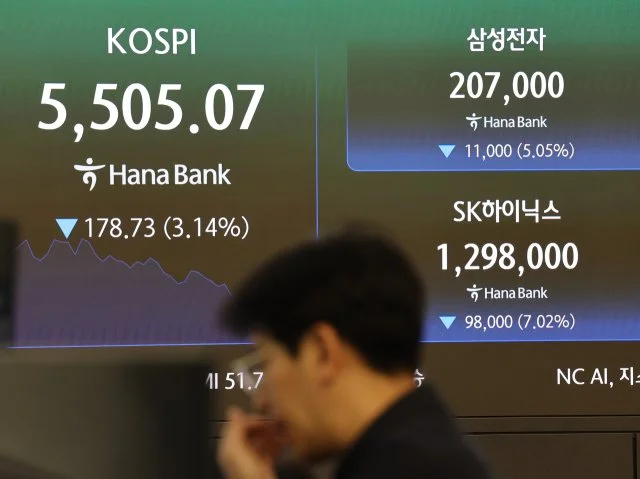
KOSPI experienced a crash recently.
The initial potential impact on South Korea of the crisis was obfuscated by the protection of the chaebols. Even though many measures have been taken to correct that problem, the economy is still overly dependent on chaebols. As this is being written, South Korea is facing another financial challenge. South Korean chaebols are among the top producing companies of chips used for AI. SK Hynix produces 60% of the global high bandwidth memory (HBM) chips used in AI and Samsung produces another 20%. The fears raised after the 2026 U.S. mid-term elections that new regulation may be coming for AI and data centers has sent stocks in these companies tumbling. Questions about whether these stocks and companies are overvalued have emerged. Their prominence in the country’s economy continues to create vulnerabilities. We will have to watch carefully and see if a new kind of financial crisis could still hit South Korea hard.
Film and TV
A number of films and TV series have touched on or focused on the 1997 financial crisis in South Korea. The most notable is the 2018 film Default. It looks in detail at the negotiations between the IMF and the South Korean government and the Bank of Korea. It is, of course, fictionalized, but contains newsreel clips and gives a good sense of the tone in the country and the government at the time.
You can watch Default on Viki and Prime Video
Other films and TV shows that have the 1997 financial crisis as a subject or major theme include:
The Golden Empire (2013) – Kocowa
Reborn Rich (2022) – Viki
Bogotá – City of the Lost (2024) – Netflix
Typhoon Family (2025) – Netflix
Big Deal (2025) – The Roku Channel, Tubi, YouTube, Viki
Twenty-Five Twenty-One (2022) – Netflix
Undercover Miss Hong (2026) - Netflix
