By April Maas
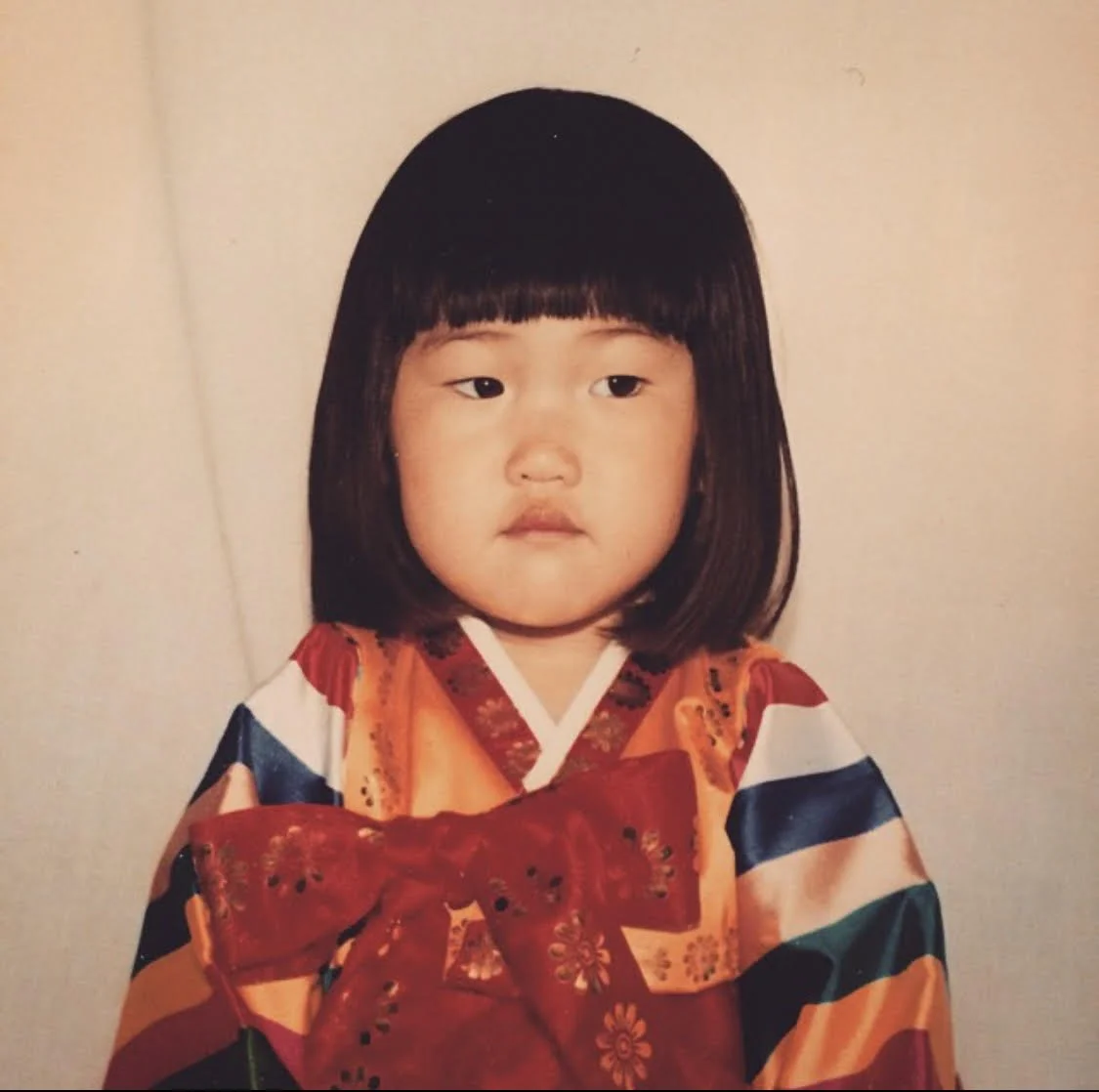
My parents got this hanbok for a first birthday ceremony, but it was huge on me. They continued to put it on me each birthday until it fit. I'm 3 or 4 here.
A few months ago I took a solo trip to Seoul seeking retail therapy, semi-invasive skin care treatments, and TMJ relief. Midway through my trip I scheduled a sound bath and acupuncture at WooJooYoon Clinic, a Traditional Korean Medicine (TKM) practice housed in a picturesque hanok at the top of a hill in Bukchon, complete with a view of Namsan Tower. I had several TKM appointments lined up for specific treatments, but I had booked this one purely on aesthetic. During my intake with Dr. Woo Joo Yoon, it naturally came up that I was an adopted Korean-American tourist. The doctor shared that she often treated adoptees seeking trauma healing and would adjust my treatment accordingly. What followed was completely unexpected and transformative. In a session combining sound, light, acupuncture, manual adjustments, and meditation I was led to understand the following:
The separation of adoption is a trauma, regardless of the circumstances or outcome.
Generational trauma lives in your genetic makeup, whether you are aware of your ancestral history or not.
Living things adapt over millennia to optimize their survival for their specific geographical environments, including humans.
I don’t know if these now obvious truths never occurred to me or if my subconscious mind suppressed them as too big and threatening. I suspect the latter, because while the two hours I spent sobbing on the floor of Woo Joo Yoon’s sound bath room were more productive than a decade of therapy, I’m now left with even bigger questions to grapple with:
How do you heal trauma you don’t remember?
How do you grieve for your ancestors’ suffering when your biological ties have been cut?
How do you nurture a body that is evolutionarily misplaced?
I have no idea. None at all.
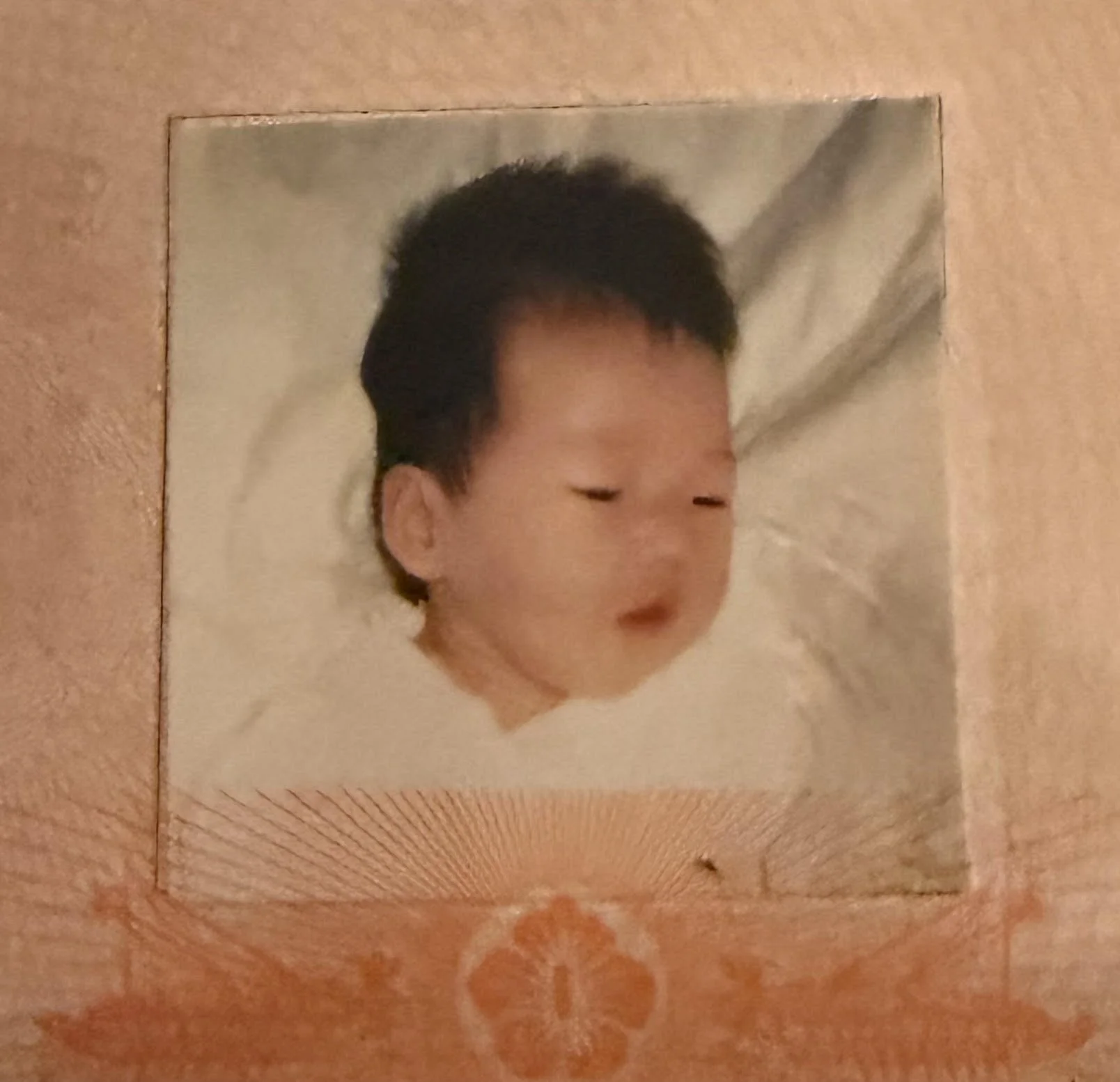
My infant passport photo. My Korean name was Bo Ah Choe.
Here’s what I do know: from the end of the Korean War through the mid-90’s well over 130,000 children were adopted from South Korea to Western countries. These numbers peaked in the late 80’s, facilitated by a corrupt and predatory adoption industry . I was one of these babies: assigned to my parents at birth and delivered to them three months later. There were enough babies on my flight that our parents, having met at the airport, created a robust playgroup that stayed intact through our pre-school years, when the adults finally admitted they had absolutely nothing in common except having imported a Korean child to southeast Michigan. It was 1988 and South Korea was hosting the Summer Olympics. While awaiting my arrival, my parents recorded the primetime coverage of the games every night, in case I wanted to watch it when I grew up. The VHS tapes are still in their basement somewhere.
Last year, my mom decided I was old enough to be the keeper of my own administrative history and gifted me two overflowing file folders that contained everything from my naturalization paperwork to Sesame Street Live ticket stubs. Stuffed between my parents’ pre-adoption home visit report and a Frost Middle School Honor Roll certificate, I found an undated essay, written by me and notated with my mom’s neat copy edits. Reflecting on my adoption experience, the essay borders on Nationalistic, with the thesis being “I may be adopted, but I am AMERICAN FIRST.” Adult me could not be more embarrassed by this earlier version of myself. This painfully naive version of me wrote, “I was carried off the plane by a ‘greeter’ and placed in my mother’s protective arms. From there I never looked back.” That, at least, remained true for the next 30-ish years - until I was eventually forced to turn around.
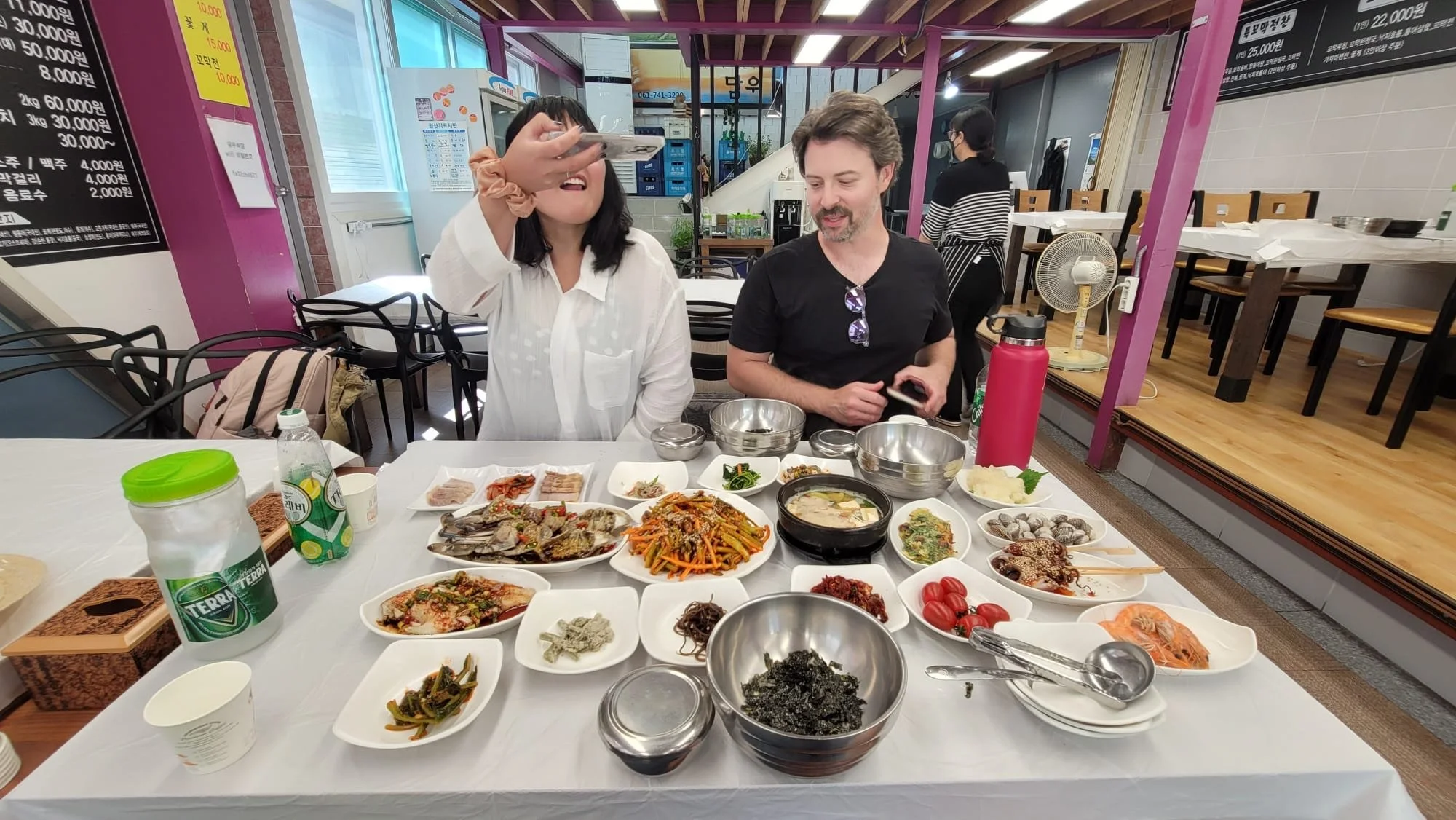
With my husband on our honeymoon, my first trip to South Korea.
I enjoyed the comfy childhood of the Midwestern suburbs: well-loved, well-cared for, and well-resourced. My parents spoke openly about my adoption from my earliest consciousness, but only with the utmost positivity. I was special because I had been chosen by them; my birth parents made a great sacrifice because they loved me so much; I was beautiful and I didn’t owe anything to anyone who made me feel different. I happily adopted this white-washed approach to anti-racism popular in the 90s and early 00s and went about the hard work of fitting in. What began as a distancing from my adoption story and Korean identity in adolescence eventually calcified into an internalized racism so dysfunctional that even my white friends found it unnerving. My “fear” of “large groups of Asian people” was so well known that a group of girlfriends didn’t even bother to invite me on a trip to Japan in our early 20s, knowing (correctly) that I wouldn’t go. Even as my already left-leaning politics trended more and more progressive, I failed to reconcile the contradiction.
Then came the 2016 election. Then George Floyd was murdered. Then I was marching and screaming with rage and terror. It became harder to ignore that despite years of casually claiming my racial identity as “basically white,” that wasn’t at all true, and as a transnational adoptee I was, in fact, an immigrant. Around this time, Nicole Chung published her adoption memoir, All You Can Ever Know, a book that quite literally changed my life. Reading it felt like looking into a mirror and realizing every other mirror I’d ever used had reflected a distorted, partial image. If my visceral outrage at the acute threat of fascism motivated me to finally dismantle my internalized racism, then Chung’s book gave me the language and the confidence to, at least theoretically, reclaim my identity as a Korean adoptee.
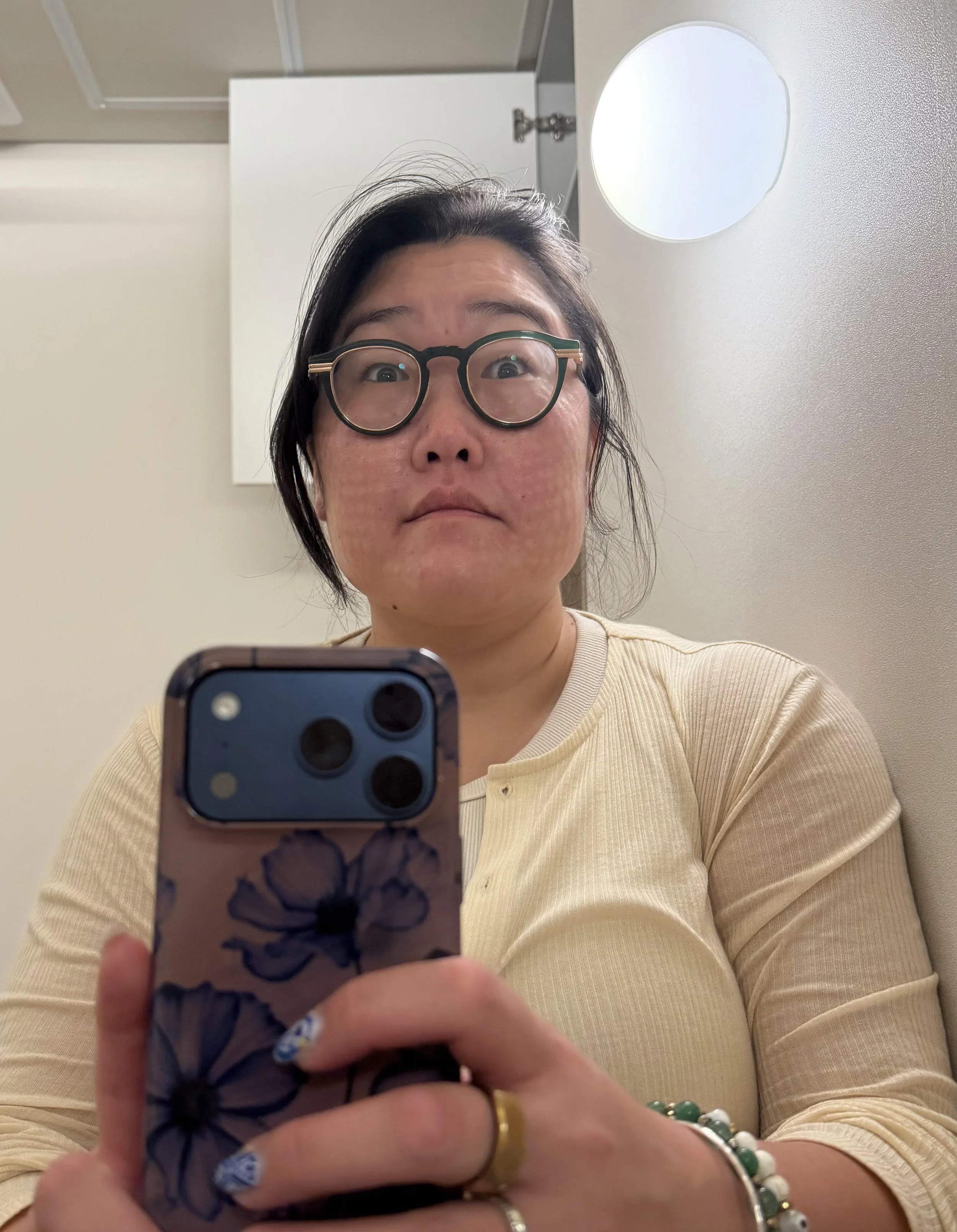
I did get Rejuran (ie: PDRN ie: salmon DNA ie: the noted salmon sperm injections) on my last trip to Seoul and have zero regrets.
I can’t decide if it’s incredibly lucky or unfortunate that my personal Korean awakening has coincided with the exact moment that South Korea has become the coolest country on the block. On one hand, it has given me the opportunity to ease my way in, with entrance points that are both approachable and joyful. If you’re diving into the sea of unresolved trauma, a newfound BTS obsession is a lovely life raft to keep you swimming (pun intended). But, as someone who has always been embarrassingly trend driven, I’m self-conscious that my newfound interests will be perceived at best as jumping on the bandwagon and at worst the cringe of an aging millennial trying to be cool. So what if my entire FYP is Park Jimin sticking his tongue out and glowing influencers explaining why having salmon sperm injected into your face will make you young forever? Isn’t that what the rest of the Internet is doing anyway?
For this reason, among many others, my Korean identity sits uncomfortably. After years of outright rejecting my Koreaness, I now long for something that I still can’t quite claim as my own. Faced with the vastness of what I do not know, I haven’t quite convinced myself that I deserve a seat at the table. As a transnational and transcultural adoptee, the cultural and racial identities of my adoptive country are things I’ve spent a lifetime cultivating, earning, and performing. I struggle to accept the idea that being Korean is something I just am.
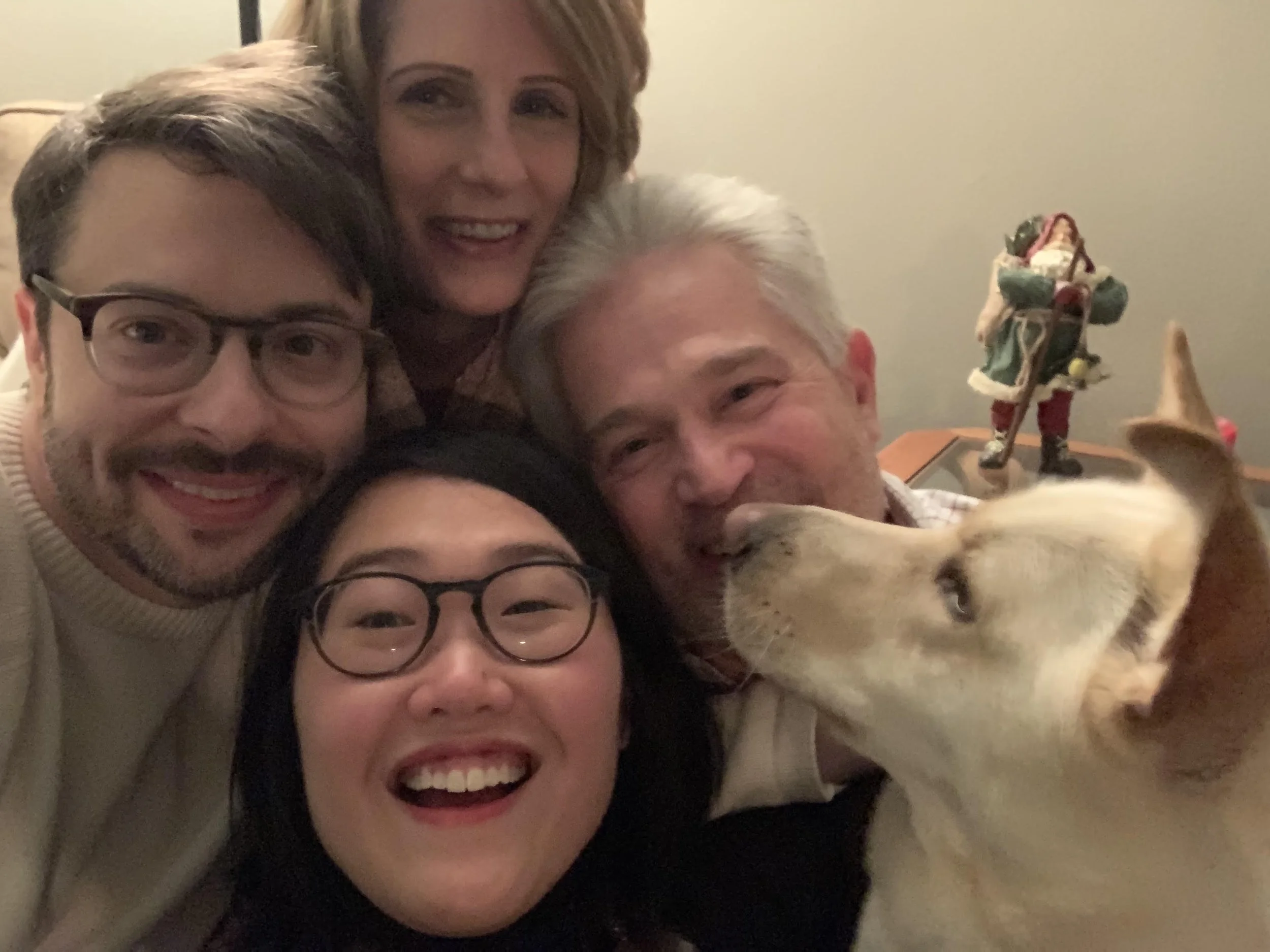
My parents, husband, and sister dog.
I find myself in a liminal space that I have avoided my whole life. In asserting my Americanness I refused to entertain any ambiguity about who I was or where I came from. In her essay “Babyland” from the collection, When the World Explodes, Amy Lee Scott recounts a conversation I, and I’m sure others, have had verbatim: “‘Aren’t you beautiful!’ Adults gushed when they saw me with my white mother… ‘Where are you from?’ ‘Ohio,’ I’d reply stonily. ‘No,’ the well meaning interrogator would blush… ‘I mean, where are you from from?’ ‘Ohio,’ I’d repeat, and walk away.” Having to explain your existence to fit within the context you live in is inherently destabilizing. In rebuffing others’ curiosity I maintained tightly held control over my story. I’ve found the frequency of the invasive (and racist) question of “where are you from from?” has decreased significantly over the years, but if I were asked now, my honest answer would be “it’s complicated.” As a perfectionist control freak (classic trauma response), the ambiguity is deeply unsettling.
This essay has somehow ended up both longer and less complete than I intended. Each paragraph feels like a thought-starter for the layers of personal experience, complex trauma, and socio-political dynamics underneath it. So, I invite anyone who is miraculously still reading and might want to continue the conversation to reach out. I’m new (to the metaphorical) here and the novelty of connection is still fresh. Hearing others’ adoptee stories, my nervous system jumps up and down and yells, “Me too! Me too!” I see you. You’re safe here.